
What is the Chelsea FC logo meaning? Unlocking the secrets of the Blue Lion
Founded in 1905 at the Rising Sun pub, Chelsea Football Club was born with an ambition that matched its affluent surroundings. While the world now recognizes the team through its royal blue identity, the early years were defined by a much different persona centered around the veterans of the local Royal Hospital. Over the past 121 years, the badge has navigated through several radical redesigns, moving from elderly soldiers to minimalist monograms and eventually settling on the regal predator we see today.
Throughout every era, the crest has served as a visual anchor for a club that prides itself on being "The Pride of London." At livescore808, we believe the Chelsea FC logo meaning is a masterclass in blending community heritage with the ruthless competitive edge required at the top of the Premier League.

What is the Chelsea FC logo meaning?
The current emblem is a sophisticated tribute to the club's 1950s heritage, modernised for a global audience in the early 21st century. When supporters investigate the Chelsea logo meaning, they discover a deep connection to the Earls of Cadogan, who once held the title of Viscount Chelsea. The central figure is a blue heraldic lion rampant reguardant, which was part of the Cadogan family's coat of arms. This lion is not just a fierce animal; it carries a staff, or crozier, belonging to the Abbots of Westminster, whose jurisdiction once extended over the lands of Chelsea.
Surrounding the central lion are several smaller details that complete the narrative. Two red roses sit on either side of the circular frame, acting as traditional symbols of England, while two footballs represent the club's sporting core. The entire design is bathed in a deep "Royal Blue" and held within a double-bordered ring featuring the club's name in bold, clean typography. This balance of aristocratic heraldry and athletic purpose ensures that the Chelsea logo meaning remains a symbol of both elite status and local grit, standing distinct from any other brand in English football.
The historical evolution of the Chelsea crest
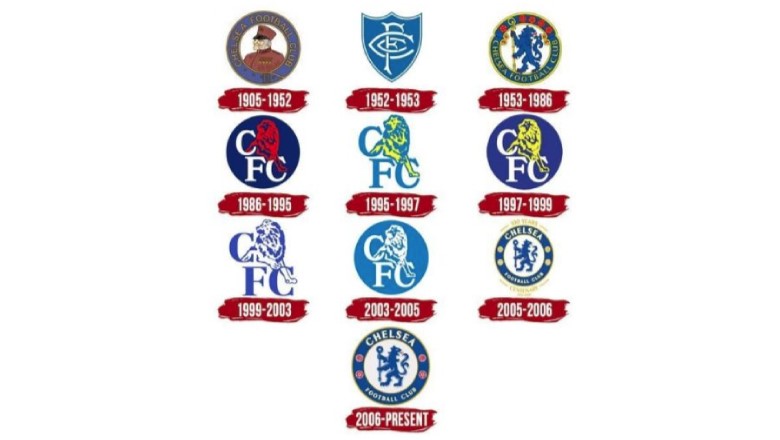
1905-1952: The Pensioners era
For nearly half a century, the club was known as "The Pensioners." The inaugural badge featured a bearded veteran of the Chelsea Royal Hospital, complete with his medals and cap. While this design was beloved by local fans and gave the club its first nickname, it was never actually worn on the players' jerseys, appearing only in matchday programmes and official club documents.
1952-1953: The transition monogram
Following the arrival of manager Ted Drake in 1952, the club sought a more "modern" and aggressive identity. Drake famously demanded the removal of the Pensioner badge, leading to a temporary circular logo featuring the blue initials "CFC" on a white background. This was a short-lived phase used while the creative team developed a more permanent symbol.
1953-1986: The classic heraldic lion
This era introduced the most famous version of the lion and crozier. Inspired by the Cadogan coat of arms, this logo presided over Chelsea's first league title in 1955 and their first European successes in the early 1970s. It established the blue lion as the definitive spirit of Stamford Bridge, though the design was often simplified for embroidery on the kits.
1986-2005: The minimalist lion and monogram
In a move toward 1980s minimalism, the club adopted a simpler logo featuring a non-heraldic lion sitting atop the "CFC" initials. While this version was used during a period of significant growth and the arrival of international stars like Gianfranco Zola, many fans felt it lacked the historical depth of the previous shield. It remained the official face of the club for nearly two decades.
2005-present: The centenary return to roots
To celebrate the club's 100th anniversary, Chelsea returned to the 1953 heraldic design but with a modern, high-definition polish. This version brought back the crozier, the red roses, and the royal blue lion. This icon has witnessed the most trophy-laden period in the club's history, including multiple Premier League titles and two Champions League trophies, solidifying it as a worldwide symbol of dominance.
Chelsea logo evolution and history:
1905-1952: The original Chelsea Pensioner badge
1952-1953: The temporary circular CFC monogram
1953-1986: The first heraldic lion and crozier
1986-2005: The minimalist lion and initials era
2005-present: The modern refined centenary crest
Impact on club culture and global identity
The logo of Chelsea is a powerful cultural bridge between the fashionable streets of the King's Road and the global world of elite sports. Locally, the crest is a mark of prestige that distinguishes "The Blues" from their London rivals, embodying an image of success and cosmopolitan flair.
Globally, the lion rampant is a certificate of excellence; when fans in Asia or America see the blue lion, they associate it with a club that is always a contender for the biggest trophies. This consistent and regal brand identity has allowed Chelsea to maintain its status as a world-class institution, blending old-world English tradition with a forward-thinking global commercial strategy.

Understanding the Chelsea FC logo meaning reveals a club that is fiercely protective of its history while always looking toward the next trophy. From the original veterans to the modern blue lion, every pixel of the crest tells a story of survival, elegance, and victory. We just have analyzed every era of this legendary badge to show why Chelsea remains a pillar of English footballing greatness.
To stay ahead of the game as the Blues navigate another high-stakes season, being informed is your greatest advantage. Visit livescore808.mobi today to catch the latest football news, expert analysis, and real-time updates on every Chelsea fixture as they continue their hunt for glory.
The Most Popular
-
 How many months in a La Liga season? Inside the intense annual calendar of Spanish giants
 -
 Australia football team kit history: How the Socceroos changed their look over the decades?
 -
 5 France biggest losses in football history: Three of them came from an arch-rival
 -
 All Messi records that you need to know: The whole world El Pulga had conquered!
 -
 Top 17 players who played for both Chelsea and Arsenal: No.1 signing triggered a bitter lawsuit between two London clubs
 -
 What position does Neymar play? “Little Pelé” and the playing style behind a legend
 -
 Belgium national football team players World Cup 2026: 10 Red Devil stars ready to steal the show this summer
 -
 Why did Makelele leave Real Madrid? Zidane’s warning and the dawn of the first Galacticos downfall
 -
 How much did Real Madrid pay for Beckham? Blockbuster signing with influence far beyond football
 -
 How much did Man City pay for Jack Grealish? The journey from England’s most expensive player to a forgettable flop